UAS Mission Maintenance Tracker
An aircraft-centered prototype for keeping maintenance conditions, mission events, parts status, and readiness context connected to every unmanned aircraft.
UAS — Unmanned Aircraft System: the aircraft plus the control components and personnel required to operate it.
Prototype overview
A concept build focused on maintenance continuity
The tracker models how an unmanned aircraft's condition, discrepancies, parts, and mission history stay connected over its full service life — including short-life and one-way airframes.
The aircraft is the record
Every entry attaches to a tail number, not a shift, a spreadsheet, or a single file.
Symbols carry meaning
Red X, Red Dash, and Red Diagonal express release state without interpretation.
Readiness is answerable
Condition, parts, operator, and route resolve into one readiness view.
The operational problem
Readiness answers usually live in people, not records
Small UAS programs move fast, and maintenance history scatters across spreadsheets, message threads, and printed forms. When an aircraft moves between teams or deployments, its condition history rarely moves with it.
- Discrepancies recorded per event instead of per aircraft.
- Parts blockers discovered after mission assignment.
- Release meaning that varies by who is on shift.
- No structured record of one-way or expendable outcomes.
Capabilities
What the prototype models
Aircraft-centered records
Every discrepancy, corrective action, and release decision attaches to a tail number and stays with it across workspaces and deployments.
Maintenance symbols
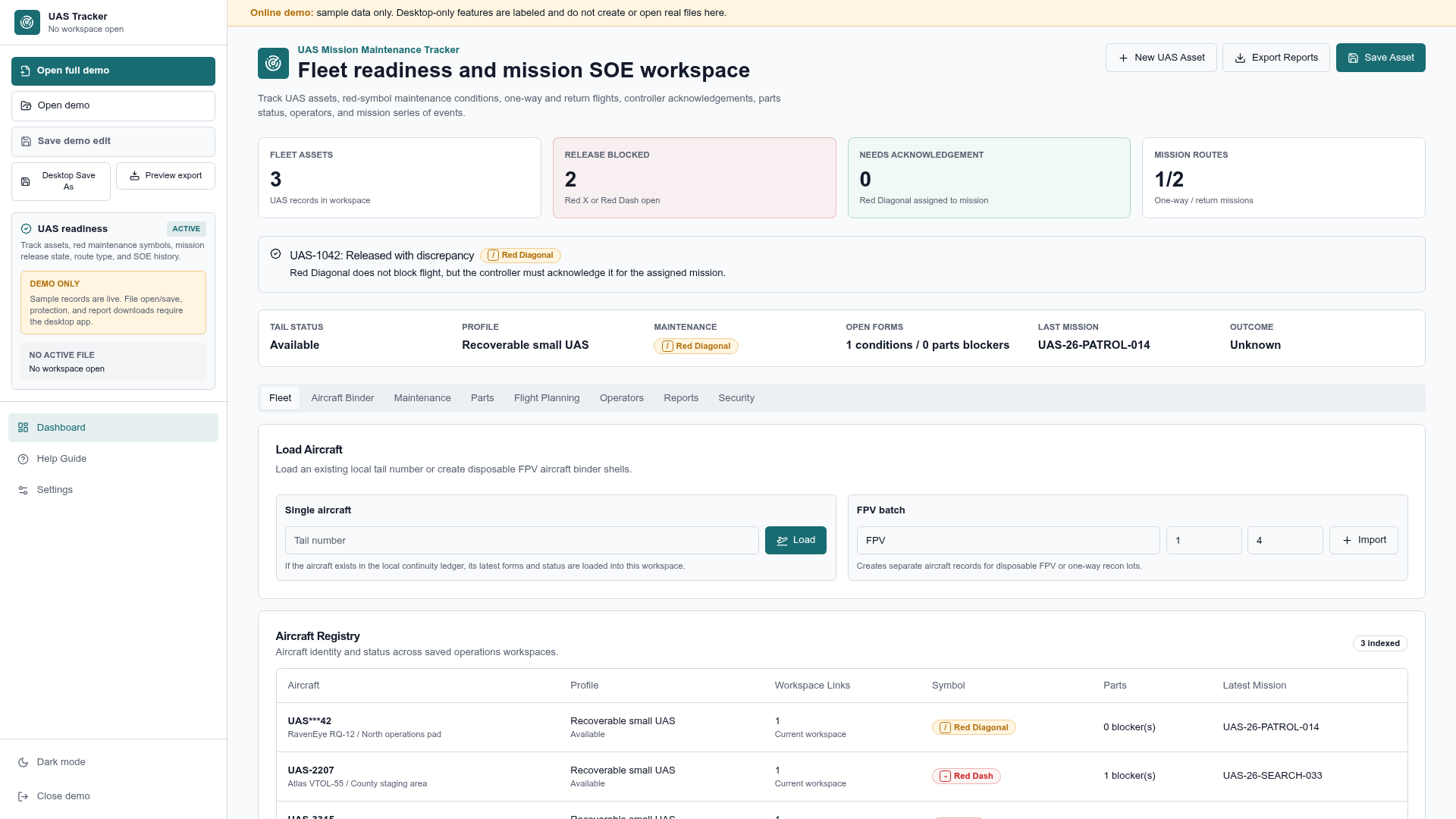
Red X, Red Dash, and Red Diagonal states carry explicit release meaning, including which conditions block flight and which require controller acknowledgement.
Parts status and blockers
Open parts requirements surface before mission planning, not after an aircraft has already been assigned.
Mission series of events
Mission SOE captures the sequence of a sortie: assignment, acknowledgements, route type, execution, and outcome.
Operator qualifications
Operator currency and qualification context sit alongside the aircraft record used for the assignment.
One-way and return missions
Route type is a first-class field, so expendable profiles are modeled as normal operations rather than exceptions.
FPV and disposable aircraft
Batch aircraft creation and lightweight binders fit short-life airframes without forcing a full inspection history.
Professional readiness reports
Exportable readiness and maintenance reports built for briefings, handovers, and program reviews.
Standout concept
Aircraft Readiness Passport
One view that combines maintenance condition, open discrepancies, parts status, operator status, route detail, and readiness checks for a single aircraft — the answer to “can this aircraft fly this mission?” in one place.
UAS-1042 / READINESS PASSPORT
RED DIAGONAL- Maintenance condition
- Red Diagonal — acknowledgement required
- Open discrepancies
- 1 condition / 0 parts blockers
- Parts status
- No open blockers
- Operator status
- Qualified, current
- Route detail
- Return mission — UAS-26-PATROL-014
- Readiness check
- Released with discrepancy
Architecture
Local-first by design
Local-first workspaces
The workspace file on the operator's machine is the source of truth. No connectivity required to read or record.
Encrypted desktop files
Encrypted workspace files, desktop persistence, and native exports belong to the desktop application.
Explicit continuity
Aircraft history follows the tail number across workspaces through reviewable, intentional merges.
Collaboration
Open, organization-led collaboration
This project is being developed through an open, organization-led collaboration. We welcome developers, UAS professionals, communications experts, designers, researchers, testers, educators, and people bringing transferable experience from every background.
Contributor participation is open. The current prototype is privately maintained while governance, licensing, security standards, and future public repositories are established.
Latest updates
From the project blog
7/31/2026
What Local-First Data Means for UAS Operations Teams
Operations happen in places without reliable connectivity. The data model should assume that.
7/23/2026
Designing Maintenance Tracking for FPV and One-Way UAS
Disposable and one-way aircraft break the assumptions built into traditional maintenance systems.
7/14/2026
Why Aircraft-Centered Maintenance Continuity Matters
Maintenance history belongs to the aircraft, not to a spreadsheet, a shift, or a single workspace file.
Gallery
Real interface views
Screenshots of the working prototype: dashboard, aircraft binder, maintenance, flight planning, readiness passport, and reports.
FAQ
Common questions
- Is this a finished product?
- No. The UAS Mission Maintenance Tracker is a prototype and innovative concept project. It is not certified, not production-ready, not an official maintenance authority, and it does not provide flight authorization.
- What does UAS mean?
- UAS stands for Unmanned Aircraft System: the aircraft together with the control components and personnel required to operate it.
- Is the demo using real data?
- No. The demo runs on synthetic sample data. It does not expose information entered by other visitors, and browser file operations are previews only.
- How is my data handled?
- The website stores only what you submit through its forms, along with your consent choice. The desktop prototype is local-first: workspace data stays on the operator's machine.
Help shape how UAS programs keep maintenance continuity
Contributors from every background are welcome — engineering, operations, design, research, communications, testing, education, and partnerships.